Forest Floor Ecology of the Great Lakes
The forests bordering Lakes Ontario, Erie, Huron, and their surrounding watersheds are dominated by sugar maple, beech, yellow birch, and basswood in upland sites, with red maple and ash occupying wetter lowlands. These closed-canopy systems share a defining characteristic: a brief window in early spring, typically late April through early June, when sunlight reaches the forest floor before leaf-out. This period drives the flowering of a suite of species commonly called spring ephemerals.
Spring ephemerals complete their above-ground life cycle quickly, investing the energy of a single growing season into reproduction before retreating to underground bulbs, corms, or rhizomes. They are sensitive indicators of forest continuity: intact stands with an established spring flora generally reflect forests that have not been severely disturbed in decades or centuries.
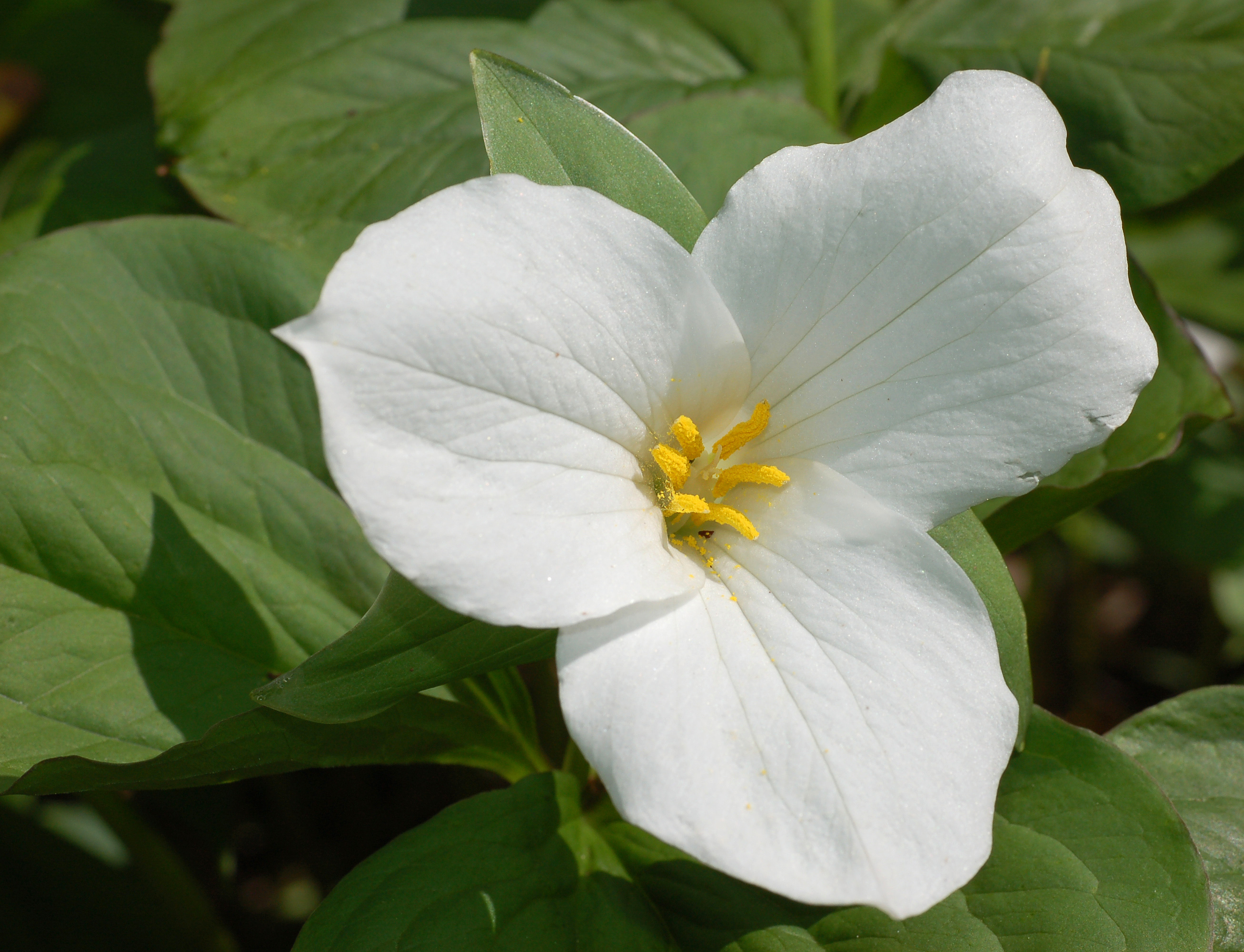
White Trillium
White Trillium
Trillium grandiflorum (Michx.) Salisb. — Family: Melanthiaceae
Ontario's provincial flower, designated in 1937, is one of the most recognisable wildflowers in eastern Canada. The three broad white petals fade progressively to pink as the flower ages, a reliable aging indicator in the field. Plants grow 20–45 cm tall, each bearing a single whorl of three broadly ovate leaves subtending the solitary flower.
White trillium is characteristic of rich, mesic deciduous woodlands with well-drained, slightly acidic to neutral soils. It grows most abundantly in forests where there is a persistent layer of decomposing leaf litter, particularly beneath sugar maple. Large patches of several thousand flowering individuals can occur in undisturbed sites, though such populations are increasingly rare due to browsing pressure by white-tailed deer.
Seeds are dispersed by ants, a process called myrmecochory. The elaiosome, a fatty appendage attached to the seed, attracts ants that carry the seed to their nest. A seedling requires approximately seven years to produce its first flower, making populations slow to recover from disturbance.
- Bloom period
- Late April — early June
- Height
- 20–45 cm
- Habitat
- Rich mesic deciduous forest
- Range in Canada
- Ontario, Quebec, Manitoba (scattered)
- Seed dispersal
- Ants (myrmecochory)
- Status
- Common; locally threatened by deer browse
Trout Lily
Trout Lily
Erythronium americanum Ker Gawl. — Family: Liliaceae
Named for the brown and green mottling of its two basal leaves, which resemble the flank of a brook trout, this species is one of the most abundant spring ephemerals in southern Ontario. The nodding yellow flower is produced on plants that have reached sufficient size, typically after six or more years of vegetative growth. A large proportion of plants in any given colony may produce only the characteristic mottled leaf pair and no flower, indicating a young population or resource-limited individuals.
Trout lily spreads primarily by vegetative means through stolons, which allows large clonal colonies to form over time. These colonies can persist for centuries. Individual colonies have been estimated to be several hundred years old based on the slow rate of clonal expansion.
- Bloom period
- Late April — mid-May
- Height
- 10–25 cm
- Habitat
- Moist deciduous and mixed woodlands, floodplain forests
- Range in Canada
- Ontario, Quebec, Nova Scotia, New Brunswick
- Propagation
- Stolons and seed (ant-dispersed)
Jack-in-the-Pulpit
Jack-in-the-Pulpit
Arisaema triphyllum (L.) Schott — Family: Araceae
Recognisable by its distinctive green and maroon striped spathe (the "pulpit") enclosing the club-shaped spadix (the "jack"), this species occupies wetter woodland conditions than most spring ephemerals. It tolerates shallow flooding in spring and is frequently found in floodplain forests and the edges of vernal pools.
The plant is functionally dioecious: smaller individuals typically produce male flowers, while larger, more resource-rich plants produce female flowers and the cluster of bright red berries that ripen in late summer. The sex of a given plant can change between years depending on stored food reserves.
All parts of the plant contain calcium oxalate crystals and are intensely irritating if consumed raw. The corms were processed and consumed by Indigenous peoples after extended cooking or drying, which destroys the crystals.
- Bloom period
- May — early June
- Height
- 30–60 cm
- Habitat
- Moist to wet woodland, floodplain forest, streambank
- Range in Canada
- Ontario, Quebec, Nova Scotia, New Brunswick
- Fruit
- Bright red berry cluster, ripens August–September
Round-lobed Hepatica
Round-lobed Hepatica
Anemone americana (DC.) H. Hara — Family: Ranunculaceae
One of the earliest wildflowers to bloom in the Great Lakes region, hepatica pushes flowers through leaf litter while patches of snow may still be present on the ground. Flowers range from pale blue to white to pink, with colour varying among individuals in the same population. The three woolly bracts beneath the flower may be mistaken for sepals.
The overwintering leaves from the previous year persist through the bloom period and are the characteristic three-lobed, leathery leaves visible throughout the rest of the season. New leaves emerge after flowering. Hepatica is associated with calcareous or circumneutral soils in mature forest.
- Bloom period
- Late March — early May
- Height
- 10–20 cm
- Habitat
- Upland deciduous forest, rocky slopes with neutral soils
- Range in Canada
- Ontario, Quebec
- Flower colour
- White, pale blue, or pink (variable)
Habitat Considerations and Field Notes
The presence of multiple spring ephemeral species at a site is generally an indicator of ecological continuity. Old-growth characteristics — including a multi-aged canopy, standing dead wood, and a deep litter layer — correlate with higher species richness in the spring flora. Forest edges, even adjacent to intact interior, often support substantially fewer specialist woodland species.
White-tailed deer herbivory is one of the most significant current pressures on Great Lakes woodland wildflowers. At high deer densities, trillium populations can collapse over one to two decades as browsed plants fail to flower and eventually die without replacement. Fenced exclosure studies in Ontario have documented rapid recovery of trillium and other species when deer are excluded.
Spring ephemerals are also sensitive to soil compaction from foot traffic. Where they occur near accessible trails, staying on established paths helps prevent long-term damage to populations that take many years to recover.
Sources and Further Reading
- Ontario Ministry of Natural Resources — Trillium (Provincial Flower)
- iNaturalist — Trillium grandiflorum observation data
- McGill University — Canadian Biodiversity Information Facility
- University of Guelph Arboretum — Ontario Native Plant Resources
Last updated: June 12, 2026